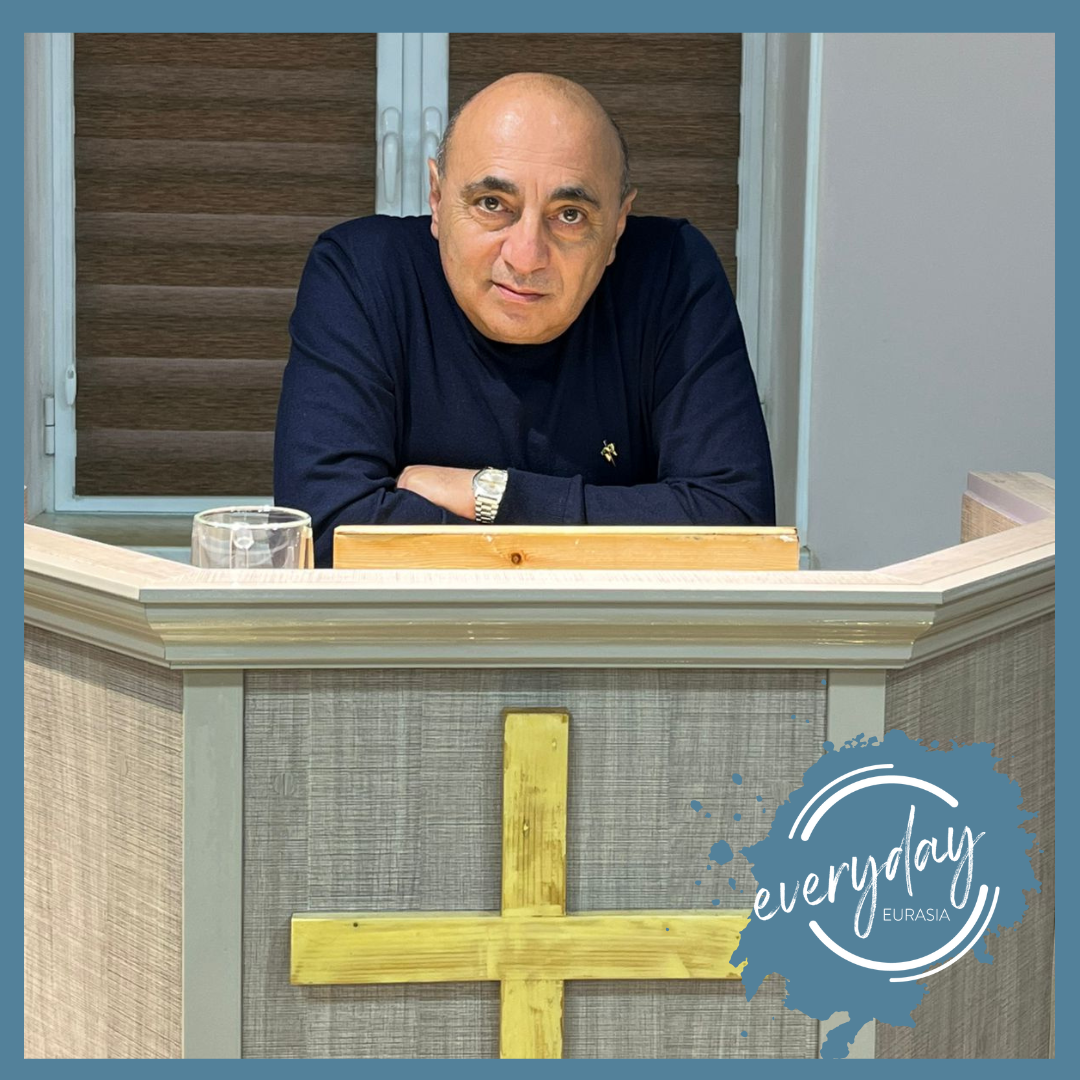
Marked by hardship, Pastor Seyran Vardanyan’s life has been poured out in great pain over decades.
On a cold and foggy December morning in 1988, 20-year-old Seyran found himself digging through the ruins of a building destroyed by an earthquake that sent the ground in Armenia swelling like the sea. For hours, he sifted through rubble and checked the faces of the dead, searching for his teenage sister, Ruzanna. Finally— miraculously—he heard her voice and rescued her, while more than 40,000 others lost their lives.
But his body paid the price. Over the coming years, Seyran experienced increasing, eventually debilitating and paralyzing pain, driven by the hours he’d spent straining against the weight of rock and ruin. He once spent six months in bed—in agony— unable to work, unable to walk, unable to afford treatment.
Seyran struggled to survive. His community was devastated; hospitals were demolished in an instant, and essential items like bread vanished overnight. He first found shelter in a tent, later moving into a metal container that would become his home for nearly two decades. In winter, Seyran remembers, the walls were so cold they froze a meter above the ground.
Several years after the earthquake, Seyran heard about Jesus for the first time. He began to consider God, but continued to live without the hope of Jesus. One day, Seyran had a vision. A man in white appeared before him. Seyran could see hands and feet, but the man’s face was hidden in a blazing light. Seyran remembers feeling “very sinful, dirty,” while the man was “light and holy.” Seyran asked for forgiveness of his sins. The man placed his hand on Seyran’s head, and he was immediately flooded with peace. “It felt like heaven,” he recalls. After years of diminishing strength, intense poverty, and disabling pain, Seyran was ready to spend eternity with Jesus.
“Jesus, I am ready,” he prayed. “You can take me home. I am ready to die.”
But God did not call Seyran to heaven that day. Instead, God gave him a mission. “Stay here and preach the gospel,” Seyran sensed God saying. Caught off guard, he argued: “I said, ‘I don’t know the gospel. I cannot speak or preach.’”Still, the message continued: “Stay here and preach.”
In obedience, Seyran purchased a bible and began to study. God opened his eyes to the truth of Scripture through revelation and education. In 2003, he met believers from a newly planted Church of the Nazarene—the first of its kind in Armenia. Seyran began attending European Nazarene College, and he was eventually ordained. He started pastoring the young Akhuryan Church of the Nazarene. God was leading, but life continued to crush Seyran like an olive in a press.
Thieves robbed the Akhuryan church, stealing all of the fragile congregation’s construction materials. Neighbors turned against them for refusing to bow to a local saint, threatening members after services. For four years, Seyran received terrorizing threats—promises to cut off his head and capture his two young daughters for trafficking.
“The pressure was so heavy at times that we even considered leaving the ministry,” Seyran admits. “But for the sake of Jesus, we endured, and the Lord kept us safe.”
Today, Seyran says, many of those struggles are behind them. “We have wonderful young people,” he says, “and the church is slowly growing.” Still, challenges remain. Many are afraid to attend church openly. Poverty separates families; children grow up without parents; and ongoing conflict persists. “All of these weigh heavily on our community,” Seyran says. “Even today, we continue to live in the midst of a Christian struggle. Yet we press on, overcoming every difficulty for the sake of our Lord Jesus Christ.”
Seyran believes the Akhuryan Church of the Nazarene shares a bond with the book of Revelation’s resilient church at Philadelphia. “Years ago, I was praying to the Lord,” he recalls. “The Lord said that we are Philadelphia. We have little strength, yet we keep his word. We have few financial resources, yet we overcome difficulties. A door has been opened before us to preach the gospel, a door that no one has been able to shut.”
Though trials continue to plague Seyran’s life on earth, he has counted the cost and committed his days to Jesus. “I am ready to do my best for my God, my savior,” he says. “He loves me. He saved me.”
“I think sometimes God allows this kind of life,” he adds. “We serve God not for money or a rich life, but we serve God because we love God, and we should be faithful.”
“I don’t know what kind of future God has for us,” Seyran says, “but I believe that God has good plans for us.”