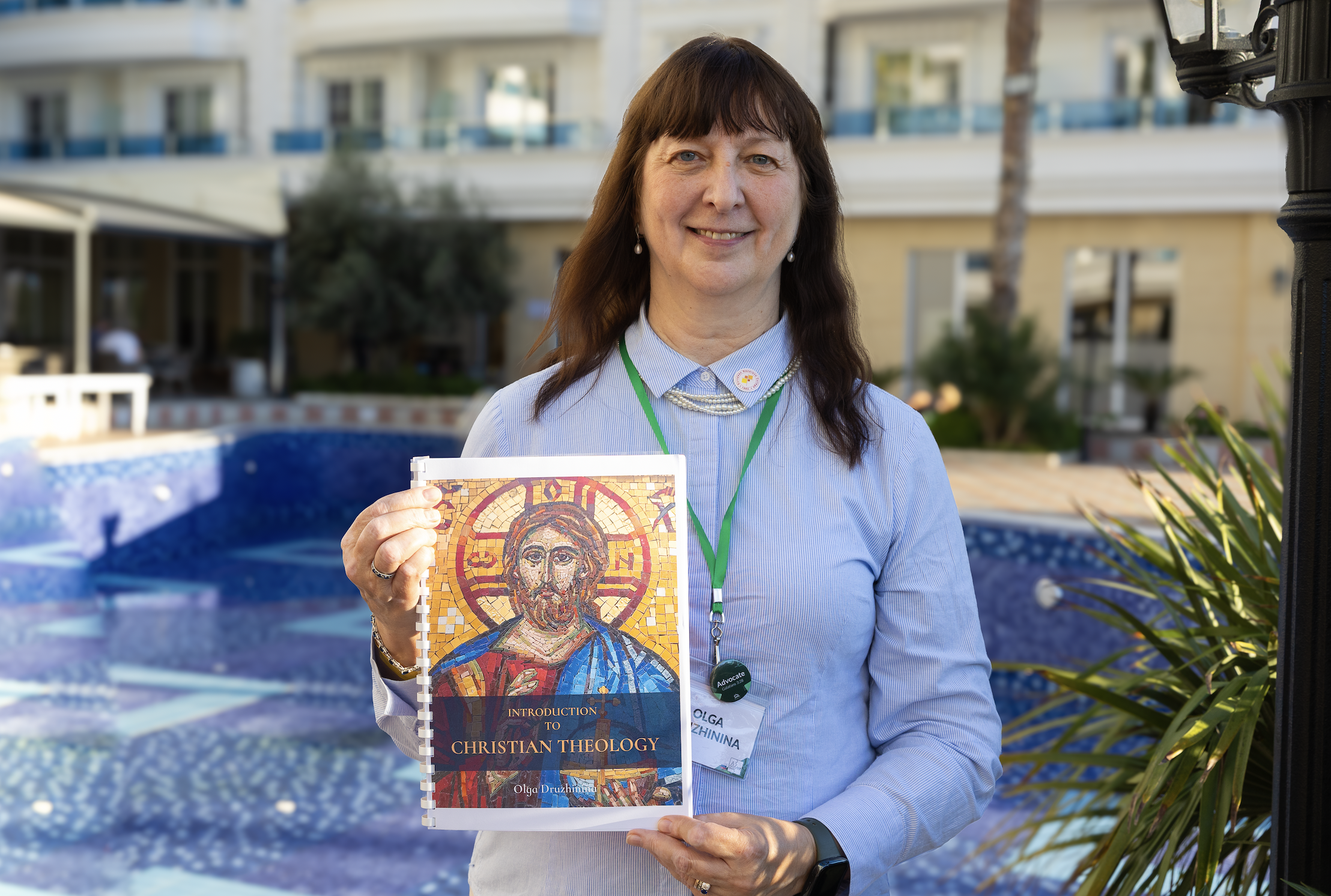
For much of her early life, Olga knew that God existed, but she did not know about Him openly. Growing up in Russia during the communist era, faith was something private and protected. Churches existed, but attending them could cost a person their job or education. Olga learned about God from her grandmother, who quietly taught her how to pray, planting seeds of faith that would take years to fully grow.
Everything began to change in the early 1990s, after the collapse of the Soviet Union. As new freedoms emerged, Olga and her husband Aleksei, already married and raising two daughters, began exploring Christianity more openly. After visiting several churches, they found a theological home in the Church of the Nazarene.
“It seems like we agree with everything,” Olga recalls. “And we realized, yes, this is our church.”
From the beginning, their calling was clear. They wanted to teach. Theology and education became central to their ministry as they studied through European Nazarene College, later moving to continue their education in Büsingen and then onto Manchester with Nazarene Theological College. Olga eventually completed doctoral studies focused on the theology of the church. Over the years, ministry also led them across borders, from Russia to Latvia and eventually to Serbia, where they now serve a Russian-speaking congregation.
It was within this long journey of teaching theology across cultures and languages that Olga’s book was born.
For years, she taught introductory theology courses in multiple learning centers, both in Russian and English. Again and again, she encountered the same challenge. Students wanted to understand theology, but the resources available to them were either too complex or not aligned with Wesleyan theology. Teachers struggled to adapt. Students struggled to engage.
“We didn’t really have a proper book for our students,” Olga explains. “They were struggling, and teachers were struggling too, asking what should we do.”
So she began writing one.
The book is an ‘Introduction to Christian Theology’ written from a Nazarene and Wesleyan perspective, intentionally shaped to be clear, accessible, and faithful. Rather than relying on dense academic language, Olga explains theology in a way that invites readers into reflection. She explores what theology is, how Christians know God, why revelation matters, and how belief connects to everyday faith and practice.
Writing in English as her second language became an advantage, helping her choose clarity over complexity and communicate across cultures. The book was originally written to serve students at European Nazarene College, but it quickly grew beyond its initial purpose. It hasalready been translated into Arabic and is now being used in theological education contexts well beyond Europe.
At the heart of the book is a conviction that theology cannot be separated from relationship.
“If you don’t know God personally, then theology becomes just information you don’t really understand.” Olga says.
For Olga, theology is not reserved for experts or academics. Every believer who reads Scripture, prays, or reflects on God is already engaging in theology.
“Any way of thinking about God is theology,” she explains. “We don’t need only professional theologians to talk about God.” What began as a response to a classroom need has become a resource for the wider church. Olga never set out to write for a global audience, but through collaboration, encouragement, and trust from church leaders, her work is now serving students, pastors, and lay leaders across cultures.
Even now, the work continues as Olga is currently writing additional textbooks focused on the Holy Spirit, the church, and Christian doctrine, responding to needs she continues to see in theological education. Alongside writing and teaching, she remains rooted in local ministry, walking with people whose lives have been shaped by uncertainty and transition.
Once, faith had to remain hidden. Today, Olga is helping the church speak about God with confidence, clarity, and humility. Her book stands as a reminder that theology does not belong only to academics. It belongs to the church, to everyday believers, and to anyone willing to think deeply and faithfully about who God is.
You can have access to her book here.
You can also listen to our devotional podcast that Olga is hosting this week on our Podcast channels here.