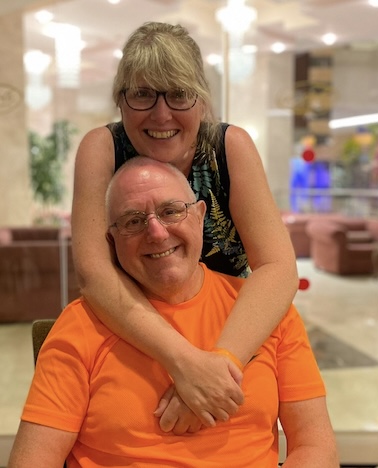
On any given day in the United Kingdom, more than 100 children are removed from their homes because of abuse or neglect. Every day, newborns are taken from hospitals to police stations, siblings are pulled out of school and split apart, and social workers already stretched thin begin the difficult process of finding dozens of safe, temporary homes. Within the Church of the Nazarene, families across the Eurasia Region have chosen to invite vulnerable children into their homes through foster caring. In Wales, Cath and Neil Lucas have welcomed 43 of those children since 2012.
“We knew. It was absolutely a proper calling,” Cath says, remembering the moment she and Neil decided to jump into foster caring. Separately, the husband and wife had seen foster caring families—Cath as a teacher and Neil at church—and both had seen children experience hope and healing.
Cath and Neil tentatively approached the other, delighted to learn the Lord had placed the same desire in their hearts. The Lucases added on two bedrooms, filed their applications, and began the lengthy process of getting approved to provide care.
“It was a huge investment,” Cath says, “but it’s obviously paid dividends. The couple has watched children experience God’s healing in various ways: some reuniting with parents, some discovering and enjoying what it means to be part of a safe, healthy environment for the first time.
Over in England, Lauren and Carl McCann also sensed God leading them to open their home. The McCanns, licensed for less than a decade, have now cared for 20 children—many of whom arrive with little more than the clothes on their backs.
Here, Lauren says, is an opportunity for believers to step in and serve their community. Often, children enter care unexpectedly, adding a level of unpredictability to an already stressful world. Fostering parents spend a lot of time and energy collecting everything a child needs to feel safe and secure during her stay.
Lauren says one way to support caring families is to provide care kits based on the family’s needs. The kits, which could include simple items like clothing, deodorant, and a stuffed animal, can help ease the transition for both carers and the children entering a new environment under difficult circumstances.
“Because the last thing that you really want to do,” Lauren says, “is when you get that phone call, to then be thinking, oh, I’ve got to go to the supermarket now. I’ve got to go and provide this child with enough clothes to see us through the week, and buy the toiletries,’ and things like that. And so, is there anything that you could provide to make that first night easier?”
Emmanuel, God with flesh on, moved into the neighborhood to be closer to humanity in its pain. And while not every Nazarene will open a home to kids in care, every follower of Jesus has the opportunity to support a family that serves kids from hard places.
Cath says her congregation has been like Aaron and Hur, holding up Moses’ hands, steady until sunset and the battle won. Her church family provides prayer and hospitality as a way to love the children in Cath and Neil’s care.
“Every child that has come through the door,” Cath says, “they’ve just accepted them.” Kids are greeted warmly on Sundays, as well as invited to birthday parties and play dates—something people are often hesitant to do with children from hard places. Not so for Cath and Neil’s community. “Our church family have just encased them,” she says.
“They’re the ones who help hold our arms up to help us do what we do,” she adds. “I don’t think we could do it quite successfully if we didn’t have our church family.”
The load for those in and around the world of foster care is heavy and often devastating, but hope is relentless. Recently, Lauren studied brain scans of two children—one who’d been raised in a healthy, loving home, and one who had experienced severe, prolonged neglect. The difference was stark and jarring.
“The healthy child’s brain was all lit up with light,” Lauren recalls, “and then the foster child’s brain was just in darkness—big patches of darkness all over.” The brains of children exposed tochronic stress are literally altered, often smaller and suffering from structural decay.
The scans were shocking, Lauren says. But amid the darkness—hope.
“What was amazing,” Lauren recalls, “is that if you give the love and the attachment and sense of security and all those things—the light comes back in the brain. And you can start to see that, over time…the darkness goes and the light comes.”
“There are beautiful moments,” she adds, when you do see change in children, and when you can just tell that they’re feeling so secure: when a child gets into their lovely fluffy bed and they pull their covers up and they just love being told a bedtime story because they’ve never had one before…when you connect with the child, when you giggle at the same time.”
“Jesus is the light,” Lauren says. “The darkness,” she adds through tears, “it can be overcome.
Ways your church can serve a family who fosters:
●Provide a meal or grocery gift card
●Create a care kit (clothing, toiletries, age-appropriate books, toys, or stuffed animal)
●Invite them over for dinner!
●Contact your local foster authority about designating a comfortable space in your church
for supervised family visitation
-photos shared by Cath Lucas and Lauren McCann